)
)
)
The Creative Code: Cracking Attention in User Acquisition with Creative Strategy
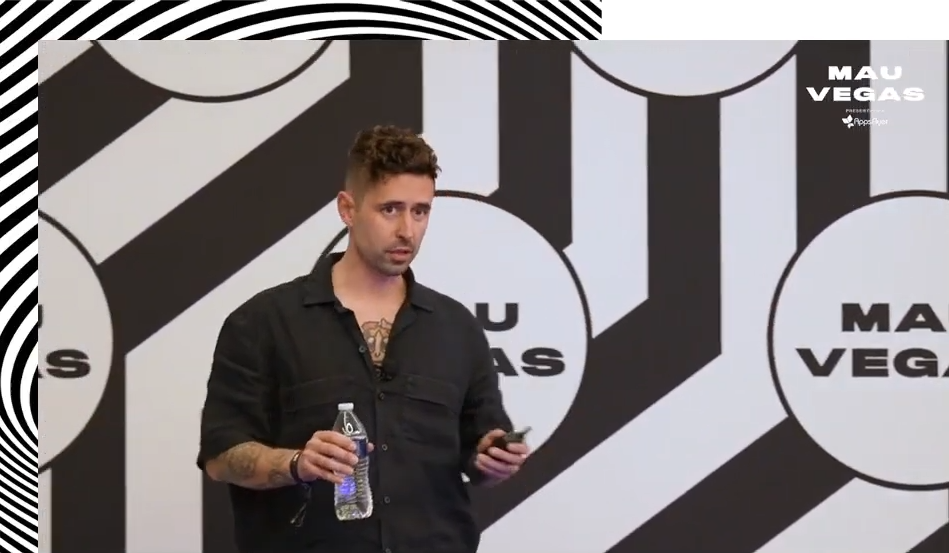
- Event: MAU Vegas 25
- Date: Thursday, May 22, 2025
- Speaker: Matej Lančarič, UA Consultant and Host, Two and a Half Gamers Podcast
- Estimated read time: 6 to 8 minutes
Quick Read Summary
Modern growth teams are no longer competing on targeting, they are competing on creative systems, and the teams that win treat user acquisition creative strategy like an operating cadence, not a campaign.
In 2025, the biggest structural problem in paid acquisition is the winner problem, a tiny number of assets capture the bulk of spend, and everyone else is burning budget on fast fatigue and false positives.
The response is not simply more output, it is modular production, faster learning loops, platform specific creative grammar, and hooks engineered to trigger emotion in the first seconds.
AI can expand throughput dramatically, but only when it supports a disciplined system that still protects product truth, creative judgment, and durable measurement across IPM, ROAS, and scale.
The winner problem is real, creative fatigue makes it worse
The defining pressure on performance teams is not a lack of channels or tools, it is the compression of attention and the acceleration of creative fatigue. In practice, even very large advertisers can produce thousands of assets, then watch the same pattern repeat, a handful of creatives take almost all the spend, because they are the only ones that clear the bar on attention fast enough. Matej captures the imbalance bluntly, “2% of the creatives still accounts for 53% of the spend.”
That statistic should change how you staff, forecast, and plan. If you accept that most of your creative slate is there to find and feed the winners, then your objective becomes system design, speed to insight, and speed to iteration. This is where user acquisition creative strategy stops being a brand exercise and becomes an operating model.
Practical implication for you: set an explicit creative fatigue policy. Define a refresh rhythm tied to spend and placement, and treat any ad that is not learning as a candidate for a new hook, not a full rebuild. Matej’s own benchmark is aggressive, changing creatives “almost every three days” on major channels.
Modular creative is the only sustainable way to keep learning speed high
The easiest mistake to make is to respond to fatigue with constant reinvention. That feels productive, but it destroys learning, because you keep swapping multiple variables at once. Modular creative flips the approach. You keep what is already proven, and you isolate the smallest portion of the asset that drives early engagement.
Matej’s concrete example is a 60 second format built in two halves. The second 30 seconds is the “meat” and the best performing part, so teams iterate “only the first 30 seconds,” swapping hooks, actors, backgrounds, pacing, and even gameplay overlays to create endless variations without losing the core payoff.
This is more than a production trick, it is an insight strategy. When the structure stays constant, you get cleaner attribution for why performance moved, and your team builds a reusable library instead of a graveyard of one off ads.
Practical implication for you: redesign your creative process around components. A simple starting framework looks like this.
- Hook module, first 1 to 3 seconds, designed to stop scroll
- Proof module, what makes the product believable and valuable
- Payoff module, what resolution looks like, win state, transformation, outcome
- CTA module, short, explicit, and placement appropriate
Then enforce a rule, if performance drops, rotate the hook module first, before you touch the rest.
Emotion is not optional, the hook must create stakes immediately
If modularity is the structure, emotion is the fuel. The sessions strongest claim is that neutral creative rarely wins. You need viewers to feel something fast, and one of the most reliable patterns is the fail state.
Matej describes what he heard from developers, “you need to have the near death experience and the anxiety and people need to feel that,” tying it directly to performance.
The reason fail state creatives keep working is not mystery, it is cognitive involvement. A mistake creates tension, and tension invites the viewer to mentally solve the problem. That micro moment of superiority, I would not do that, is often enough to buy the extra seconds an ad needs to land its proof.
Practical implication for you: build an emotional hook backlog, then test it systematically. Do not only test visual styles, test emotional triggers. A practical shortlist from this playbook is:
- Fail, obvious mistake, avoidable loss
- Urgency, countdown, imminent threat
- Chaos, too many things breaking at once
- Surprise, unexpected outcome in the first beat
Treat these as hypotheses, rotate them as hooks, measure the lift on IPM first.
UGC advertising is maturing, creators are winning with formats, not testimonials
UGC advertising is still the dominant aesthetic in many feeds, but the winning execution is evolving. The old template, “this is the best game ever,” is fading. In its place is creator generated content that borrows the grammar of native platform formats, especially listicles and explained narratives.
Matej calls out the shift directly, moving toward “top five reasons” style creative, and similar creator led formats that make the ad feel like content first, sales second.
He also points to the rise of low fidelity work that looks almost handmade. In one example he describes an ad that “looks really native,” even “ridiculous,” yet “works really well.”
This matters because it changes your production constraints. You no longer need every iteration to be high polish. You need fast, believable, and contextually native.
Practical implication for you: treat UGC advertising as a format library. Build briefs around repeatable structures, not open ended creator freedom.
- Top five list, fast reasons, quick proof shots
- Desk recorded playthrough, commentary over gameplay
- Reaction style, stitched or duetted energy, even if shot internally
If you do not have creator budget, use internal talent. Matej’s Longleaf Valley example performed strongly with a UA manager shooting in an office, including a staff support animal, precisely because it read as real.
Platform specific creative is not a nice to have, it is table stakes
For senior teams, the temptation is reuse. If an asset wins, why not scale it everywhere. The problem is that each channel has its own viewer expectations and engagement triggers, and reuse often strips away what made the creative native in the first place.
Matej’s line is the one to print and pin above your creative desk, “it’s not 2015 anymore,” and “every channel has a different creative winner.”
He connects this to motivation mapping, what motivates players behaves differently across social networks and ad networks, meaning the same concept may require different framing, pacing, sound design, and story angle to land.
Practical implication for you: maintain one concept, many executions. Keep a shared concept brief, then create platform builds that intentionally diverge.
- TikTok build, pace sensitive, music aware, creator grammar
- Meta build, instant clarity, stakes, strong visual contrast
- Shorts build, clean arc, quick setup, visible payoff
You can still reuse modules, but only when the module fits the platform’s rules.
AI expands throughput, but only if you protect the human layer
AI is now embedded in the creative toolchain, but it should not be treated as a replacement for strategy. Matej’s most useful framing is pragmatic. AI can help with reporting and tagging, and it can accelerate production, but “it still needs the human touch,” even as it makes the team “ten times more efficient.”
He also calls out how quickly the execution frontier is shifting, including AI avatars and synthetic scenes, and notes that some categories, like forex, are adopting these approaches faster than others, because novelty itself can earn attention, especially on Facebook.
Practical implication for you: deploy AI in three specific layers, with clear guardrails.
- Insight layer, tagging, clustering, creative postmortems
- Ideation layer, script drafts, hook variants, angle expansion
- Production layer, fast variants, background swaps, synthetic elements
Then define what AI cannot do, decide product truth, decide what the viewer must believe, decide the emotional claim you are making.
Story and purpose can lift performance, if it is grounded and specific
There is a reason purpose driven creative so often fails, it overreaches. But purpose can also be a credible differentiator when it is specific, shown simply, and tied to real mechanics.
Matej’s example is Longleaf Valley, a merge game framed with real world impact, “for every player milestone, they plant real trees,” tied to Eden Reforestation.
The mechanism matters. The narrative is not vague, it is action, milestone, tangible outcome. That makes the story feel less like virtue signaling and more like a product feature.
Practical implication for you: if you have a purpose element, translate it into a single, testable claim and show it quickly.
- What action does the user take
- What outcome happens
- How do you prove it in a single visual beat
Then validate with ROAS, because purpose creative that drives installs but attracts the wrong users is still a loss.
Measure creative like an investor, not like a traffic manager
The final trap is measurement. Creative teams often over index on early signals, especially CTR, because they are fast. But fast does not mean true. Matej’s evaluation framework is a simple triangle, scale, IPM, and ROAS, and he explicitly looks for the combination of all three.
This is the standard you need if you want fewer false winners. IPM tells you if the creative is efficient at converting attention into installs. ROAS tells you if the promise matched the product. Scale tells you if the performance survives budget pressure.
Practical implication for you: create a graduation gate for every concept.
- Gate 1, IPM threshold for efficiency
- Gate 2, ROAS threshold for truth and value
- Gate 3, scaling test before you declare a winner
This is how user acquisition creative strategy becomes repeatable, rather than hopeful.
Conclusion
The creative code for 2025 is not a secret format or a single hook, it is a system that assumes creative fatigue, plans for it, and iterates faster than the market. The headline is structural, when 2% of creatives can take 53% of spend, your job is to build the factory that finds, protects, and evolves those winners.
Modular creative keeps learning clean, emotional hooks create stakes, UGC advertising wins when it borrows real creator formats, and platform specific execution is non negotiable. AI multiplies speed, but only teams with strong human judgment and clear measurement will turn that speed into profit.
About the Speaker
Matej Lančarič, UA Consultant and Host, Two and a Half Gamers Podcast. Matej is a long standing user acquisition consultant with more than a decade in the global gaming industry. He works with studios of every size to build creative strategy systems that deliver repeatable performance across channels. His approach focuses on modular production, rapid iteration, and creator first UGC advertising supported by practical AI workflows. He also hosts the Two and a Half Gamers podcast, where he shares insights from active campaigns and conversations with leaders across the mobile ecosystem.