)
)
)
Cutting-Edge Personalization: The Future of Lifecycle Marketing
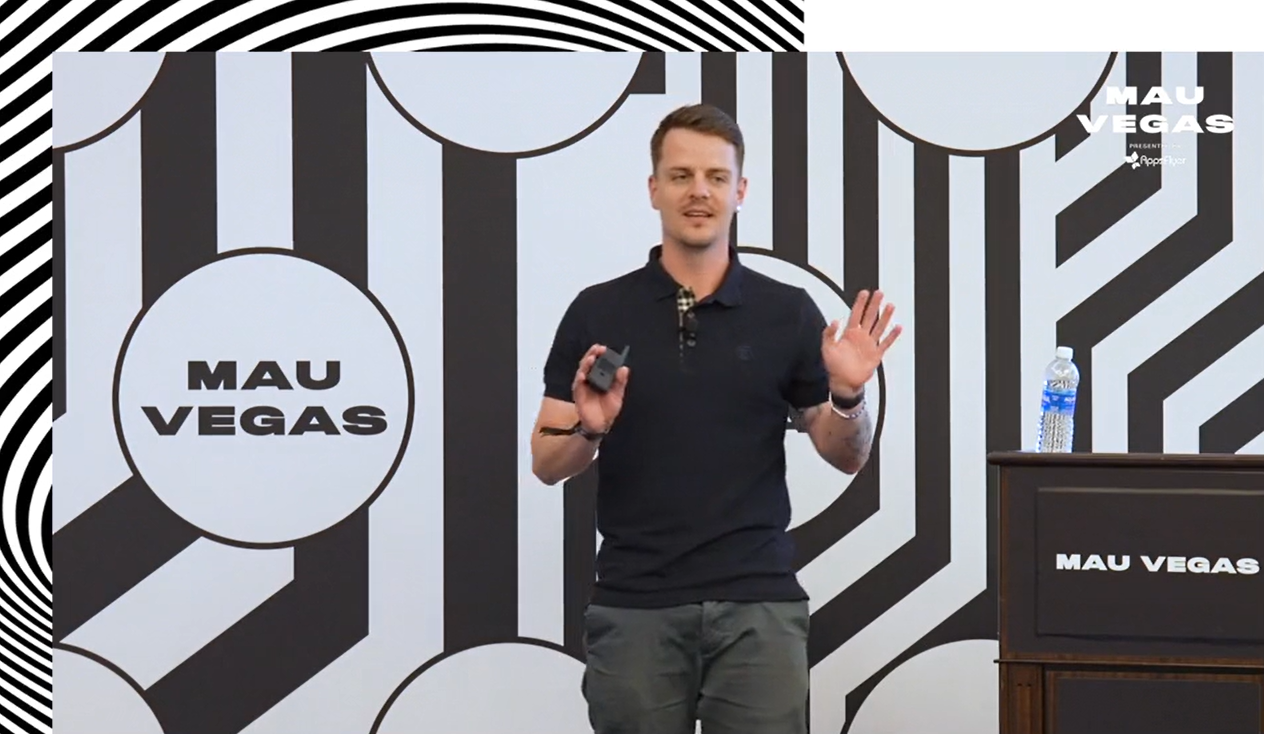
- Event: MAU Vegas 25
- Date: Thursday, May 21, 2025
- Speaker: Robert Vaternam, Senior CRM Manager, Freeletics
- Estimated read time: 6 minutes
Quick Read Summary
Lifecycle marketing personalization is stuck in a familiar pattern, modern tooling wrapped around the same static journeys, the same onboarding funnels, and the same high volume messaging that trains users to tune out.
Robert Vaternam’s argument is simple, most apps still deliver a prepared, largely identical experience to everyone, often a fixed 14 day onboarding funnel, with only cosmetic changes such as swapping an image. The outcome is predictable, users feel like a number.
The shift he is pointing to is bigger than better segmentation. He describes a future where CRM becomes “cognitive,” a mediator that knows when to speak, when to stop, and how to adapt tone and timing to the user’s emotional context.
For senior growth and product leaders, the practical takeaway is that relevance is now an operating model problem. Dynamic onboarding funnels and trust based communication require product, BI, and CRM to design the relationship together, and to measure success in something closer to permission than clicks.
The real problem is not channels, it is sameness
Most teams already run the modern channel mix, app, web, email, push. That is not the hard part anymore. The hard part is that the experience still feels prebuilt and uniform, even when it is labeled personalization.
Vaternam’s concrete example is the 14 day onboarding funnel that exists for every customer. Even when there is a difference like female versus male, it can boil down to an image swap in an email while the rest stays the same. When users learn that the system does not respond to what they do, “every user just feels like a number,” and the program becomes background noise.
If you want lifecycle marketing personalization that actually changes behavior, start by treating sameness like technical debt. Pull up your top onboarding and activation journeys, then ask one blunt question, what would need to change if a user behaves differently on day one, day three, and day seven. If the honest answer is “almost nothing,” you have found the work.
Over messaging is a trust problem, not a frequency problem
Vaternam frames emotional engagement as the hard challenge. Brand can do it, but CRM inherited a lot from sales, and sales can feel pressuring when someone reaches out to sell and “get your trust.”
He links that to what users experience today, companies over message app users, it feels like too much, and it becomes irrelevant messaging. The user response is not subtle, they opt out of push notifications, unsubscribe from emails, and complain about popups because they are “completely annoyed.”
The most practical move here is to build restraint into the system, not just into the copy. Instead of asking “how often can we message,” ask “what signals tell us we should stop.” Then operationalize it with simple rules you can defend, such as tightening eligibility after repeated ignores, pausing after complaints, and reducing pressure when users show signs of fatigue. Once that suppression layer exists, every campaign you build becomes safer and more effective.
Predictive CRM is still mostly backwards looking
Academically, “predictive CRM” has been discussed for years, but Vaternam argues that much of what teams do today is still a familiar loop, analyze past data, build predictions from learnings, and call it progress. He compares it to how sales managers operated decades ago, except the knowledge used to live in someone’s head.
He is also direct about how AI gets used in practice, segmentation, targeting, cohorts, then teams label the result “smart,” even though it is often just analysis moved into a different tool. The gap shows up in the user experience, “it’s not really personalized,” because the experience does not change based on what the user actually did.
His fitness example makes the point in plain terms. If you did a hard upper body workout, you should not get another hard upper body workout the next day. You might need a rest day, a leg day, a run, or stretching. That is personalization rooted in recovery and context, not a segment label.
A useful way to apply this is to pick one decision where “next best action” is real, not theoretical. Define what the system is deciding, what signals it uses, and what it must never recommend. Keep it narrow, then make it reliable. This is how dynamic onboarding funnels stop being a slogan, because the journey becomes a set of choices rather than a fixed sequence.
AI is not the innovation, mediation is
Vaternam does not treat AI as a magic wand. He notes it is hard to implement, and even hard to define what “AI” means in CRM. You can use AI for images, copy, and button colors, and still deliver something that feels robotic, a system placed in front of the user’s face with an implicit message, use it as it is, or you are not the right customer.
His future model is more demanding. He describes CRM becoming “cognitive,” based on the emotional side of the relationship, and acting as a mediator. The mediator understands when a user needs communication, when the system should shut up, and where the user needs support or direction to use the product.
This is a helpful filter for your roadmap. If an AI feature only helps you ship more messages faster, it may accelerate the wrong thing. Prioritize AI that helps you choose better moments, reduce pressure, and adapt tone and timing. Put another way, design for silence as a valid outcome, and make sure your tooling and incentives allow it.
The future org chart makes CRM a company capability
One of the most actionable points in the transcript is organizational. Today, CRM teams “own the communication,” then coordinate with product teams and BI teams to assemble the information. In the future Vaternam describes, CRM becomes a strategic part of the company, embedded into product development and BI, and treated as a group function built around relationships, not a single team that sends.
He also predicts a role shift. A few years ago the emphasis was often technical, HTML, JSON, SQL. He argues AI will take more of the “recording part,” and what CRM leaders will bring is customer experience knowledge, and an understanding of how relationships work in real life.
If you want to move in this direction without a reorg, run a short cross functional experiment. Choose one lifecycle moment that matters, onboarding or early retention, then have product, BI, and CRM agree on the relationship rules that will govern it. What counts as help, what counts as pressure, what signals justify an interruption, and what outcomes should end messaging. You will learn quickly where your data and operating model support personalization, and where they block it.
Trust scores will replace vanity metrics as the north star
Vaternam challenges the industry’s default success metrics. Today’s mindset often leans on open rates, conversion rates, CTR, retention, and LTV. He uses an example that will sound familiar, open rates of 40 to 50 percent, conversion rate of 1 percent, then everyone else is pushed into the bucket of “wrong user.”
He predicts a different future, customers “vote” and review how well you did, and CRM earns “trust tokens,” or a trust score, as a way to judge whether the work was done well. He also references trust indexes and CRM trust scores that identify users who trust you most, which then determines what you are allowed to offer.
You do not need a perfect trust model to benefit from the idea. Start with a simple trust score that behaves like permission. Use signals you already have, such as opt ins, sustained engagement, low complaint behavior, and positive responses to helpful messaging. Then connect the score to real constraints, for example, you only increase commercial pressure when trust is high, and you lower cadence when trust drops. That single linkage forces lifecycle marketing personalization to earn the right to be present.
Omnipresence will blur product, marketing, and support
Vaternam’s long range view assumes your product sits across many surfaces, phone, watch, smart speaker, car, AR lenses, creating a 360 omnipresent relationship. In that world, CRM becomes less about pushing notifications and more like a relationship friend, present to give what the user needs in the moment.
His example is deliberately human. After a bad night’s sleep, you sit all day at the computer, and the Apple Watch notices you have not moved for eight hours. It suggests a workout because your back will hurt tomorrow. You reply that you had a party, slept very little, and do not feel up for a big workout, so it suggests stretching instead. He emphasizes there was no app open, no button tapped, and the customer does not even realize there is a CRM team behind it. It is collaboration between product and CRM, and it avoids being the pushy, communication driven app that tries to place messages on every open.
Most teams are not building for speakers and watches tomorrow, but the principle is immediately useful. Context beats cadence. If you can connect signals to genuinely helpful guidance, users experience CRM as support instead of interruption. That is the heart of cognitive relationship mediation, and it is also the most defensible form of personalization.
Conclusion
The future of lifecycle marketing personalization in Vaternam’s framing is not louder automation. It is a move from static journeys to cognitive mediation, from a channel owned campaign team to company wide relationship design, and from click based metrics to trust based permission. Teams that adopt this stance will not just improve performance, they will reduce opt outs, preserve attention, and build a system that can scale without eroding the relationship it depends on.
Speaker
Robert Vaternam, Senior CRM Manager, Freeletics. Robert is a mobile CRM expert and marketer based in Dresden, Germany. He has worked in direct sales and offline CRM management, and has experience across dating, education technology, gaming, health ecommerce, and fitness.