)
)
)
UGC vs AI Actors, Where to Invest
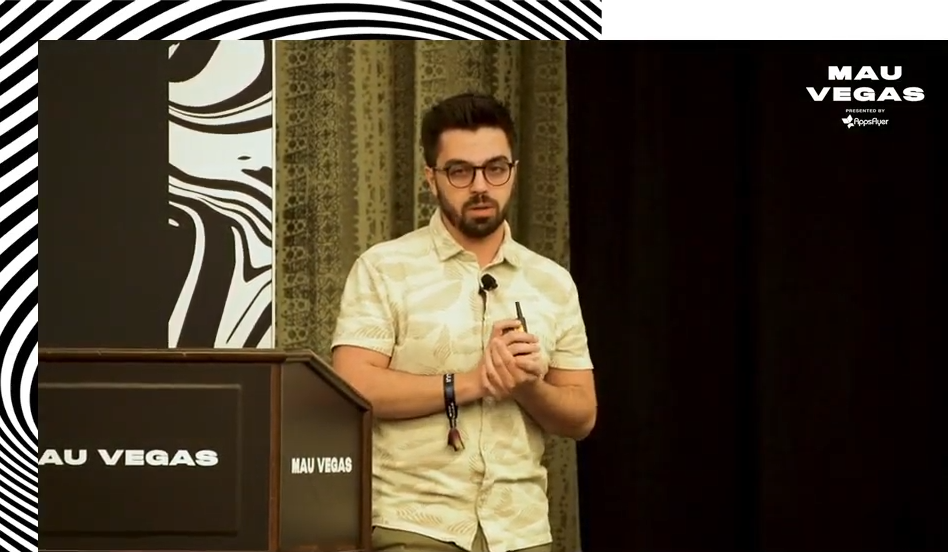
- Event: MAU Vegas 25
- Date: Thursday, May 22, 2025
- Speaker: Diogo Martins, UA Lead, DraftKings
- Estimated read time: 6 to 8 minutes
Quick Read Summary
UGC versus AI actors is not a fork in the road, it is a portfolio decision.
Most teams should keep UGC as the performance engine because real people still win on charisma, believability, and spontaneous delivery.
AI actors earn budget when speed, control, and localization matter more than human nuance, especially in regulated categories where script drift creates real risk and real delays.
The smartest investment strategy is to design a workflow where UGC produces the highest impact concepts, and AI fills the gaps, rapid refreshes, long tail segments, and smaller markets that rarely justify full production.
The real business problem, creative demand is outpacing production
Mobile growth leaders are living in a permanent creative crunch. You need more iterations, across more placements, with more variants, and you need them faster than your production system can comfortably supply. The result is a familiar pattern, performance spikes, creative fatigue, then a scramble for the next batch.
The wrong response is to treat UGC and AI actors as competing religions. The right response is to treat them as tools with different failure modes.
Diogo Martins framed it bluntly in the context of Jackpocket’s creative pipeline, you do not pick one, you use both.
“Should the money go to user generated content or AI, the answer is both.” Diogo Martins, UA Lead, DraftKings
Practical implication: your budget conversation should shift from format preference to task allocation. Decide which parts of the creative workload require human credibility, and which parts require operational speed and control.
UGC is still the persuasion layer, because humans signal trust
Claim: When you need an ad to feel true, UGC remains the highest leverage bet.
Evidence: Martins describes why UGC rose in the first place, audiences stopped believing celebrity endorsements that felt mismatched, and they wanted relatable, normal people who look like actual users.
He also highlights structural upsides, UGC is often cheaper than celebrity talent, and creators may grant more flexible usage, including evergreen runs, compared with strict likeness windows typical of celebrity deals.
Interpretation: UGC is not just a production method, it is a trust mechanism. The minor imperfections, the cadence shifts, the quick gasp, the organic gestures, all of that functions as a credibility cue.
That is also why UGC tends to win in head to head performance comparisons. Martins is clear that for Jackpocket, UGC generally performs better because of charisma.
Action: Keep UGC at the centre of your creative strategy for concepts that require emotional buy in. If the message depends on felt excitement, social proof, or a believable personal story, allocate budget to UGC first, then use AI to extend what works into cheaper variants.
AI actors are a control system, they trade charisma for speed and precision
Claim: AI actors win when your constraints are speed, compliance, and variant volume, not human performance.
Evidence: Martins describes the core promise, you can generate an AI actor creative in minutes from a script. That speed is not a convenience, it is a structural advantage in regulated environments.
He gives a concrete compliance example, in New York they cannot say “play the lottery”, yet UGC creators still say it, which triggers reshoots and delays. With AI, you change the script and rerender quickly.
Interpretation: AI actors are best understood as a reliability layer. They reduce variance in delivery, and they compress the revise to publish cycle. That matters any time legal review, policy restrictions, or fast moving news creates a narrow window where creative must ship now, not next week.
Action: Use AI actors as your default option for compliance sensitive messaging, rapid iteration, and high volume adaptation, particularly when a delay costs more than a small drop in charisma.
Do not copy UGC, design around AI’s tells
Claim: AI actors can look convincing, but only if you build creatives that hide what AI is bad at.
Evidence: Martins points out the common tells, monotone delivery, limited inflection, and unnatural blinking. He also notes that when the actor is front and centre, the lack of charisma becomes obvious, while making the actor smaller and focusing attention on the product reduces the uncanny effect.
He also flags production hacks that sound counterintuitive but work, cropping hands because AI hand movement can look frantic, and minimising facial close ups to avoid blink oddities.
Interpretation: AI actors are not a drop in replacement for UGC framing. If you try to make AI behave like a human influencer, you amplify the weaknesses. If you make AI a narrator supporting product footage, you get the benefits while reducing perceptual risk.
Action: Build an AI specific creative template library, with rules such as these.
- Prefer product led layouts, actor as a small on screen narrator
- Avoid tight face framing, avoid long uninterrupted takes
- Reduce or crop hands if movement reads as forced
- Use AI voice or third party voiceover only when inflection quality meets brand standards
AI is a model, your scripts need an engineering mindset
Claim: AI actor performance is often limited by script formatting, not by the concept itself.
Evidence: Martins shares several failure cases. Double punctuation confused the model and produced gibberish. Hashtags and symbols caused delays or errors, he had to write “number one” instead of using a hashtag, and the dollar sign broke the output.
Interpretation: This is less like directing talent and more like prompt hygiene. Teams that treat AI scripting as a craft, with guidelines and QA, will outperform teams that treat it as a button.
Action: Create an AI script style guide and QA pass that includes
- Spell out symbols, currencies, and ranks
- Avoid unusual punctuation patterns
- Standardise promo code formatting
- Run a quick render check before creative review
- Log recurring bugs by vendor and actor, escalate quickly when patterns appear
Investment decision, think in jobs to be done, not formats
Claim: The right spend split comes from mapping UGC and AI to distinct jobs in your creative system.
Evidence: Martins outlines where AI is uniquely useful, spokesperson testing, localization, reaching smaller segments, urgent refreshes, and tutorial style product walkthroughs. He also gives a clear example of an urgent refresh trigger, a customer won $112 million, and the team needed creative quickly while the moment still mattered.
He also highlights the economics of localization, UGC becomes expensive in smaller markets, while AI can produce local language variants cheaply enough to justify experimentation.
Interpretation: AI is best when you are buying optionality. It lets you test markets, segments, and news moments that would otherwise be ignored because the production cost never pencils out.
Action: Use this simple allocation framework.
1. Put UGC budget behind your highest value concepts: Use UGC for the messages you want to scale broadly, where authenticity is the primary performance driver. Assume UGC is your baseline for core markets and core angles, because it generally wins.
2. Use AI to de risk choices before you pay for human production: AI can help isolate a single variable, such as age or gender of the spokesperson, because cadence and script remain constant. Run these tests, then commission UGC that matches the winning persona.
3. Use AI for markets, languages, and segments that do not justify a UGC batch: If a market is experimental, or spend is limited, AI can create workable localized assets and unlock learning without a large upfront commitment.
4. Use AI as your rapid response layer: When the window is short, news, policy shifts, seasonal hooks, AI lets you ship while the moment still has heat, then follow with higher quality UGC once the concept is proven.
Brand risk and due diligence, the parts teams underestimate
Claim: The biggest risk is not technical, it is reputational and vendor driven.
Evidence: Martins notes that audiences can react negatively when they detect an AI actor, interpreting it as cost cutting, which can damage credibility. He also stresses partnering with vendors who can fix bugs quickly, and he describes early issues such as the “Terminator eye” effect around glasses that required vendor iteration.
On due diligence, he frames AI actor vetting as analogous to UGC creator vetting, trust in the partner and legal review matter either way.
Interpretation: AI makes production easier, which means it can also make low quality output easier. If you do not enforce creative standards, you will ship uncanny ads faster, and you will learn the wrong lesson, that AI does not work, when the real issue was craft and governance.
Action: Treat AI actor vendors like performance critical partners.
- Demand clear SLAs for bug fixes and quality issues
- Ask how actors are sourced, licensed, and protected
- Build a brand safety review checklist specific to AI tells
- Run a social sentiment scan on early launches to catch negative perception early
A practical starting point, a hybrid workflow that scales
If you want a concrete operating model, here is a straightforward approach based on Martins’s underlying logic.
- UGC produces your hero concepts and your highest performance variations
- AI expands winners into rapid iterations, local languages, and segmented messaging
- AI handles urgent refreshes, compliance sensitive scripts, and tutorial style creatives
- UGC returns for the proven opportunities that justify higher production cost
Over time, this becomes a flywheel. UGC finds what persuades, AI multiplies learning velocity, your creative system gets faster, and you waste less spend on large batches that miss.
Conclusion
The investment question is not UGC versus AI actors. The real question is whether your creative operation can produce enough quality variation, fast enough, without losing trust or compliance control.
UGC remains the strongest tool for persuasion because humans still deliver signals of authenticity that AI struggles to replicate. AI actors earn their place when the business needs speed, precision, localization, and volume, especially when delays are expensive and scripts must be exact.
Invest accordingly. Build UGC for impact, build AI for coverage, and connect them with a workflow that treats each format as a specialist, not a substitute.
About the Speaker
Diogo Martins, UA Lead at DraftKings, has more than six years of experience developing user acquisition strategies for high growth and tightly regulated categories. His work focuses on creative testing, mobile performance, and the operational use of AI in marketing. At DraftKings, he manages significant UA budgets and has become an early adopter of AI actor technology across multiple markets.